Friday, September 19, 2014

What's worked to cut greenhouse gas emissions, and Klein, etc.

Apparently there's going to be a parade, or a protest, or something in New York this weekend which caused Torontonian Naomi Klein to release a book that's getting lots of attention in prospective marching circles.

The Economist does a  good job, with the graphic, of reminding people that standards accomplish things. So to, it seems, do big capital intensive projects.

Curbing climate change: The deepest cuts | The Economist:
ON SEPTEMBER 23rd 120-odd presidents and prime ministers will gather in New York for a UN meeting on climate change. It is the first time the subject has brought so many leaders together since the ill-fated Copenhagen summit of 2009. Now, as then, they will assert that reining in global warming is a political priority. Some may commit their governments to policies aimed at reducing greenhouse-gas emissions. What few will say is how many tonnes of carbon dioxide these will save—because they almost never do. 
According to scientists, cutting carbon-dioxide emissions is an essential part of reducing catastrophic risks from climate change. Yet governments are persistently averse to providing estimates of how much carbon a policy saves. That may be because, in countries where climate change is controversial, it makes more sense to talk about the other benefits a scheme offers rather than its effect on carbon. Or it may be that, in countries which are enthusiastic about renewable energy, pointing out that it may not save that much carbon is seen as unhelpful. Or perhaps governments think climate change is so serious that all measures must be taken, regardless of cost (though their overall lacklustre record suggests this is not the case).
Continue reading at The Economist

Tuesday, September 16, 2014

The Big Stick: Cap and Trade in the Peoples Republic of Carbon

A good summary article from Maximillian Auffhammer.

I'm really not sure if notable peope are wise enough to avoid noting the cap-and-trade purpose is to protect the apparently very powerful incumbant generators (and miners, etc.), or if somebody, somewhere, actually thinks it's an honest alternative to a carbon tax.

The Big Stick: Cap and Trade in the Peoples Republic of Carbon | Energy at HAAS:
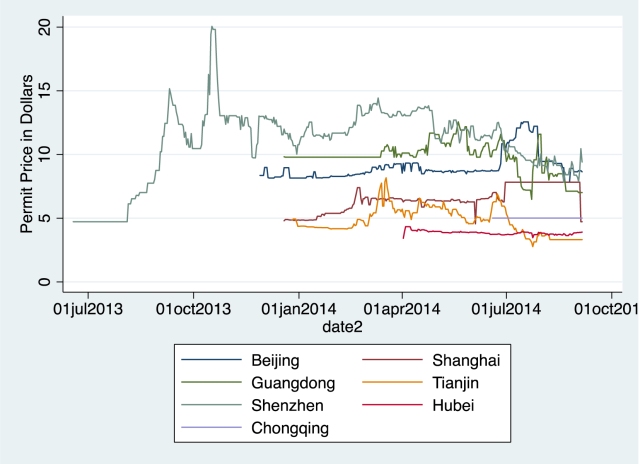
The National Development and Reform Commission, which is the arm of the Chinese government responsible for economic planning, has provided coarse outlines of a national market starting in 2016, which will cover 3-4 billion tons of CO2 with a volume of roughly 65 billion US Dollars by 2020. This is twice the volume of the European market. And some simple algebra suggests that the planners expect permits to trade at just below $20, which is higher than anywhere else in the world currently or in any of the regional markets in China. This is exciting news and will surely provide some significant momentum in the upcoming climate talks. 

I am somewhat puzzled by the apparent choice of a national cap and trade system over the other price based alternative to a CAT: a carbon tax. The reason I am puzzled is deeply rooted in some simple political economy. Cap and trade generates valuable assets (permits), which are frequently handed out to carbon intensive industries, which would otherwise fight the regulation and possibly prevent it from being implemented. If the government hands out permits, it gets no revenues from these permits.

Sunday, September 7, 2014

California solar projects, or methane projects ...

California solar projects plan undergoing major overhaul - SFGate:
... solar plants were rushed through the environmental approval process. Miles of unspoiled desert lands were scraped and bulldozed to make way for sprawling arrays of solar panels. Desert tortoises required mass relocation, and kit fox burrows were destroyed. Surprise troves of American Indian artifacts found in the Mojave Desert were moved to a San Diego warehouse, where they remain.

And once it was built, the largest solar plant of its kind in the world - the Ivanpah installation in the Mojave - began igniting birds and monarch butterflies that fly through intensely concentrated, reflected sunbeams aimed at 40-story "power towers," according to a confidential report by federal wildlife officials.

Owned by BrightSource of Oakland, with investment partners Google of Mountain View and NRG Energy of Houston, the 5.4-square-mile, $2.2 billion facility was built with a $1.6 billion federal loan and went online last fall.

...BrightSource underestimated how much natural gas it would need to run the Ivanpah plant when the sun doesn't shine. And scientists now say desert soils contain vast stores of carbon that are unleashed by construction of solar facilities.
The entire article can be read at SFGate (affiliated with the San Franscisco Chronicle).

Thursday, September 4, 2014

more On Importing More Electricity from Québec

The latest Aegent Energy Advisors newsletter post is, characteristically, a substantial contribution to a discussion instigated by an insubstantial, but popular, proposal

On Importing More Electricity from Québec… | Aegent Energy Advisors Inc.:
  • Some believe that Ontario could tap into cheap imports from Québec to offset our substantially more expensive electricity. In reality, this is a complex technical and economic decision that would not reduce power rates in Ontario for many years to come.
  • With the two provinces having somewhat complementary electricity load profiles, the current market-based imports and exports between the two are working as intended: each province has the ability to purchase electricity from the other province when market conditions are favourable to do so.
  • There may be some point beyond 2018, when Ontario would need to procure additional resources to meet its adequacy target. If Québec could offer firm imports into Ontario when there is a need - at a cost cheaper than other available options - then a case could be made for firm imports.
Read the entire post at Aegent Energy Advisors Inc.:

Wednesday, September 3, 2014

Argentina and China sign deal for CANDU 6 type Atucha III

"According to sources close to these meetings, the deal involves a founding estimated in two billion dollars, aimed for Chinese products and services, including a third a country, and 32 billion dollars in Argentine origin suppliers.
The new nuclear plant will be run via a CANDU reactor through natural uranium and heavy water, and is expected to reach a power capacity close to 800 megavolts. The complex will be built in Lima town, Buenos Aires province."
More information is in a Spanish language report. From the Google translation:

Wednesday, August 27, 2014

Germany's Poorly Calculated Gamble on Renewable Energy

The Wall Street Journal has an article today (subscription) which reminded me of an article I'd read last week.
I've altered the WSJ article because I'm a poor gambler who knows some good ones - meaning people who know what facts they can, study the game, control their emotions and play the odds/stats.
Germany didn't gamble like that.

Germany's Expensive Gamble on Renewable Energy: Companies Worry Cost of Plan to Trim Nuclear, Fossil Fuels Will Undermine Competitiveness | Wall Street Journal (subscription)
...many companies, economists and even Germany's neighbors worry that the enormous cost to replace a currently working system will undermine the country's industrial base and weigh on the entire European economy. Germany's second-quarter GDP decline of 0.6%, reported earlier this month, put a damper on overall euro-zone growth, leaving it flat for the quarter.
Average electricity prices for companies have jumped 60% over the past five years because of costs passed along as part of government subsidies of renewable energy producers. Prices are now more than double those in the U.S.

Cooperation deal advances South Korea's fast reactor development

PGSFR = Prototype Generation-IV Sodium-cooled Fast Reactor

Cooperation deal to develop advanced reactor | World Nuclear News:
From source article: "GSFR's reactor system.
It is a pool-type reactor where a small core as well as
the pumps and heat exchangers of the primary
circuit are immersed in a pool of sodium coolant.
A secondary circuit develops steam and drives a
turbine-generator set (Image: KAERI)"
South Korean designers have secured help from Argonne National Laboratory to develop an advanced reactor, which is partly based on America's successful EBR-II prototype. A 150 MWe sodium-cooled demonstration unit is slated for 2028.
...
The prototype would produce 150 MWe for the grid, but its main purpose is to demonstrate its fuel: PGSFR is to use metal fuel pins composed of low-enriched uranium and zirconium, and it can be subsequently reloaded with fuel that also contains transuranic elements produced in other reactors during power generation and which are usually treated as waste. According to an International Atomic Energy Agency (IAEA) datasheet, the objective of the PGSFR project is to test the performance of this fuel, and show PGSFR's ability to transmute the transuranics.

Friday, August 22, 2014

Harmful revisionist narratives emerging for Ontario's electricity policies

I noticed the first revisionist article on August 6th; Daniel Gross' How Ontario Won the War on Coal ("It didn't even need a carbon tax of cap and trade"). Most of the column was innocuous, but I found one statement to be harmfully wrong:
The dominance of a single party dedicated to a legislative goal was the precondition for Ontario to phase out coal.
Ontario did not have a "war" on coal, it had a policy on coal-fired electricity generation.

Ontario did not have only one party dedicated to the legislative goal - in fact it was a recommendation from the final report of an all party "Select committee on Alternative Fuel Sources", in June 2002, during the rule of another party, that, "...the Ontario government shall mandate the closure of all remaining coal or oil-fired generating stations by 2015."

Discarding the reality of consensus with the silly "single party" hero, and "war", narratives, is the opposite of helpful in getting coal-fired generation reduced/eliminated in other jurisdictions.

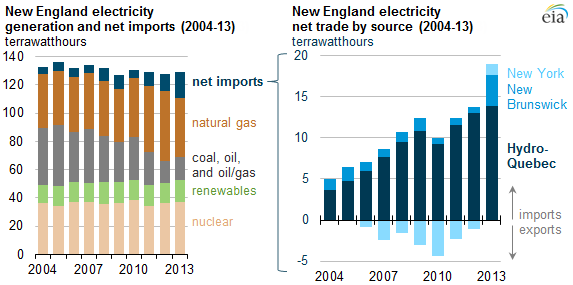
New England relying more on natural gas along with hydroelectric imports from Canada

The U.S. Energy Information Administration has a quick post today on the displacement of coal and oil-fired generation with natural gas and imports, primarily from Canada.

New England relying more on natural gas along with hydroelectric imports from Canada - Today in Energy - U.S. Energy Information Administration (EIA):
Electric operators in New England have been both generating more electricity from natural gas and importing more hydroelectric generation from Quebec over the past decade. These two sources of electricity are displacing the use of coal and oil as generation fuels in New England.
Image from eia.org

Wednesday, August 20, 2014

Greenjacked: environmental action derailed

Geoff Russell has an e-book out, titled, GreenJacked!: The derailing of environmental action on climate change. I'd tweet him (@csiroperfidy), but then he'd just respond he'd prefer I put a review on Amazon. I don't write book reviews, and this one would be rather sycophantic - which I also tend not to write.

image from Wade Allison's Energy Prices, the Climate and the Nuclear Bubble
A very brief review for those who know me well.

I bought the e-book, which itself is like getting blood from a stone.

And the review for those who know me and give me books: I read this one - right until the end.

If you are open to a reasoned argument for why fear of radiation exists, why it is grossly exaggerated, and not virulently opposed to learning some of the many things you do that are far more likely to cause your cancer than radiation, Russell's little book is an accessible entry into the subject.

As a carnivore, I'll suggest you get Joe Jackson's Everything Gives you Cancer going through your head before Russell informs you of some things worse than the radiation levels around, for instance, Fukushima. One example; "wurst is the worst."

Get Greenjacked

Not willing to shed ~$4 for an e-book?